
There are wines that speak softly, and others that speak clearly of place, effort, and conviction.
Sexto Elemento belongs firmly to the latter – a small-production, family-driven project from the Utiel-Requena plateau that reflects how quietly the Valencian interior has been reinventing itself over the past decade.
What matters here is not scale but intention: careful farming, low yields, and a refusal to simplify what is naturally complex.
Utiel-Requena has long carried a divided reputation. For decades it was associated with volume rather than finesse – cooperative production, bulk wine, and sturdy but often rustic reds. Yet the same inland landscape that once supplied anonymous blends is now revealing its finer voice, increasingly rediscovered by smaller producers who understand its true potential.
Vineyards here lie between roughly 600 and 900 metres above sea level on poor limestone-clay soils strewn with stones; summers are hot and dry, winters sharply cold, rainfall scarce, and the wide day–night swings preserve acidity and aromatic lift. It is a tough but generous landscape – one that rewards patience and precision.
At the centre of this story stands Bobal – the region’s stubborn native grape, both its challenge and its promise. Thick-skinned, late-ripening and naturally high in tannin and acidity, it is unforgiving in careless hands: push it too far in warm climates and it turns rustic; extract too aggressively and it hardens; harvest too early and it lacks depth.
It demands low yields, careful timing, restraint in the cellar, and above all a willingness to wait. Yet in sensitive hands it offers something distinctive; freshness beneath heat, deep colour without heaviness, and a savoury mineral edge that feels unmistakably Mediterranean inland.
That philosophy is evident in Sexto Elemento. In the glass it shows a deep cherry-garnet core with violet reflections, bright and limpid. The nose opens with dark fruit; blackberry, ripe plum, black cherry , followed by wild herbs, dried lavender, and a subtle mineral thread. With air, notes of cocoa, gentle spice and a faint earthy whisper emerge, always framed by freshness.
On the palate, the wine confirms its origin: structured but agile, ripe yet never heavy. The tannins are present but polished, the acidity quietly structural, carrying the fruit cleanly across the mid-palate. There is a savoury edge (balsamic, slightly saline) that anchors the fruit and gives length. The finish is persistent, dry, and composed, inviting another sip rather than demanding attention.
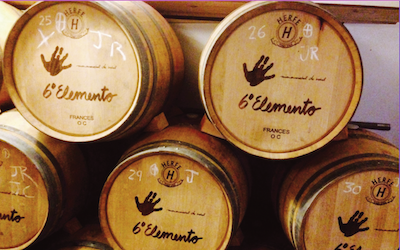
Even the presentation reflects that philosophy. Sexto Elemento dispenses with a conventional label altogether: instead, a simple sheet of paper is tied to the bottle with thread, marked with a handprint and handwritten text.
It feels provisional, almost agricultural – more like a cellar note than a finished product. The gesture is not decorative but deliberate, reinforcing the sense of a small, thoughtful project where authenticity matters more than polish.
This is a wine that pairs naturally with the food of its region. Try it with a traditional Valencian paella (rabbit and chicken rather than seafood), arroz al horno, grilled embutidos, or aged Manchego – where its structure meets salt and fat in perfect balance. It also holds its own with roasted vegetables and mushroom dishes, where its earthy tones shine.
Yes, it is priced above the everyday Utiel-Requena bottle, but here the difference is clear. Small production, careful viticulture, and the difficulty of coaxing elegance from Bobal all show in the glass. The result is something distinctive and quietly serious: not just good value for money, but genuinely different.
Serve at 15–16 °C after a short decant. 92–94 Bruja points. 19,10EUR from https://vinumlive.com/
(Feature: Wine of the Month/Valencia)
Keywords: Wine, Sexto Elemento, Utiel-Requena plateau, Bobal
news: feature, wine, sexto elemento, utiel-requena plateau, bobal, valencia