
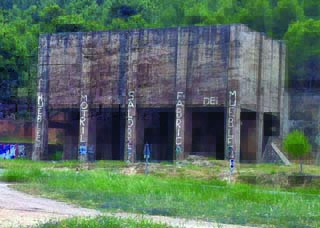
 On the 17th of May, 1927 the cable-way system linking Dúrcal to Motril was inaugurated – yes, 90 years ago there was an aerial system suspended from huge pylons bringing mineral trucks all the way down to Motril port.
The Archbishop was there to bless it and the press proclaimed it to be the second biggest such system in the whole of Europe. This was a shining example of how mountains were not obstacles to “adaptable transport.”
The new line, owned and run by the Sociedad de Tranvias Eléctricos de Granada, was declared superior to Montecattina, claimed the national press, ABC, and second only to the Hungarian line in extension (40 kilometres compared to 37).
It should be remembered that the tramlines in Granada at the time reached the Valle de Lecrín, as well as the foot of the Sierra Nevada so this final link that connected Dúrcal to Motril extended it all the way down to the coast.
The line was divided into five sections: from the Durcal tram station to Tablate (9.1km); from Tablate to Rules near the dam by the same name (6.8km); from Rules to the Gorgoracha (11.4km); from Gorgoracha to Motril (9.1km) finally from Motril to the port (2.9km).
To power this line the generators were place in the mountains around Durcal, giving 4,000 horsepower with the motors in the way stations in Dúrcal, Rules and Motril. Also along the way were nine tension and anchoring points.
The hundreds of wooden beams came from Cázulas near Otívar and from Jayena, from the days when the whole area between them was one immense pine forest.
Down at Motril Port, the terminal was next to a beach that, to this day, still bears its name; Playa El Cable, where there was a large yard and a 40-metre-long warehouse, as well as the wharf.
Along this whole structure ran 300 6-metre-long, open trucks, each able to carry one tonne and capable of carrying livestock in cages, furniture, vehicles, ore, etc, taking three hours to reach the coast. Each truck made two return trips a day, meaning that the system could transport over a thousand tonnes of material a day.
However in 1934, with pre-Civil War unrest growing, the system was only operating three days a week, mainly because of labour unrest, claimed the operating company. When war broke out in July 1936, the cable-car system almost ground to a halt so that when the war finished the system needed renovating and in 1943 a new motor was installed in Tablate, despite the international community having turned its back of Franco’s fascist regime so the company had no form of acquiring spares from abroad.
The company struggled on and the following year replaced 6,000 metres of suspension cable and 14,000m of traction cable between Tablate and Rules. The old cable wasn’t disposed of but repaired and used in the Fábrica del Pilar to Motril Port.
But in the economic background, the slow decline in sugar production (Fábrica Azucarera del Genil) was undermining part of the cable-car’s bread-&-butter trade.
In 1945 with the conclusion of the Second World War the company built a new building in Dúrcal to house the workshops where the aging trucks could be repaired; 60 had been withdrawn from service for repairs.
However, by 1946, things had become desperate: earnings were 499,452 pesetas yet there were 1,433,493 pesetas in costs. The company was bleeding to death whilst the international blockade on Franco Spain grew so that it would take only one more straw to break the camel’s back.
But it staggered on and 1947 saw 40 pylon-towers repainted and more aging cable was replaced and then an extensive breakdown in July 1948 brought the system to a halt. In 1950 the company was still spending funds on the maintenance of the inert system; i.e., to stop the installations falling apart and causing an accident.
In 1953 the government railway concession expired and the aerial-railway or cable-way line ceased to operate. From that point on and during the coming years the whole system was dismantled and sold for scrap.
The Dúrcal-Motril aerial system lived through one of the greatest upheavals during of the 20th century and received no financial support from the Government during its brief existence but despite everything it has been the only railway connection, albeit in aerial-tramway form that has ever linked the provincial capital to its coast.
Today there are concrete installations that puzzle motorists between Rules dam and Órgiva and the odd metal pylon-tower near Órgiva – the line was extended to exploit the Conjura mines. And of course, there is a beach for the use of dogs in the port area of Motril that still bears the enigmatic name, El Cable.
More reading:
CASTILLO VERGARA, A., Los Tranvías de la Vega de Granada, Ed. Proyecto Sur, Granada, 2002. 125 p. ISBN: 84-932599-5-0.
FONTANA TARRATS, J. M., Política Granadina, Ed. Paulino Ventura, Granada, 1945. 77 p.
VELASCO SOTILLOS, A., et al, Memorias anuales y actas de Tranvías Eléctricos de Granada, Sociedad Anónima, Granada, 1925-1933, Madrid, 1934-1953.