
The fishing season started in March again in Motril, after two months of borrascas and little over a month of ‘biological pause,’ scheduled every six months.
The EU fishing quotas grant 145 days of fishing per year in the Mediterranean. La Lonja of Motril organises two fresh fish and seafood auctions a day, Monday to Friday, one in the morning and one late afternoon, just after the night and day boats come in.
The bidders are all licensed fisheries or restaurants; the tempo is speedy and the environment is a paradise for seafood lovers.
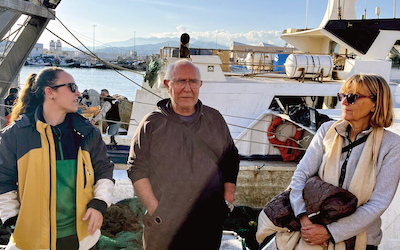
This March was the second time around Los Nordicos organised two well-attended and most appreciated visits to the fishing port of Motril, together with Angie from La Mar de Eventos.
Fifty-plus members learned how the 13 boats that are left in Motril operate, what type of fish and seafood they catch, watched a live auction and tasted many of the locally, just captured catches at the La Lonja Bar in the evening. Anyone who has not yet been there yet, can be warmly recommended!
Our guide was Maria José, a fisherman’s daughter with a lot of knowledge to share. We met her father, Ignacio Lopez Cabrera, the Patron Mayor de la Cofradia de Pescadores de Motril and chairman of several fishermen associations along the coast from Almería to Motril.
During the last 15 years he has slowly built up a consciousness and practice to achieve more sustainable fishing and care for the sea. In collaboration with researchers from universities in Cádiz and in Granada many innovations are already place.
He proudly showed us how they have achieved around 70% of protection of the ecosystems and bottom of the sea through new technology and modalities of trawling. Several projects are carried out with the universities, like the nursery of eggs from captured squid and cuttle fish (calamares y sepia), and the collection of garbage in the sea for recycling.
The local shrimps Quisquillas de Motril are divine! Do you buy fresh seafood and fish from Motril locally? You can also get it directly from the port here: https://lonjamotril.com/
Celebrating Easter – in different ways
Fish is something that also belongs to Easter celebrations – especially in the Nordic countries. Pickled herrings and salmon in different shapes and forms. Add to that: eggs, all sorts of sweets and beer brewed with special Easter spices, Easter buffets and smörrebröd, and it pretty much sums up the culinary feasts. It includes paper eggs (reused every year) filled with sweets and hidden somewhere for the youngest in the family to find.
There are no procesiones nor Santos in the Protestant/Lutheran and secularised traditions of the north. We have other specialties.
Easter in Sweden (Påsk) is a festive, family-oriented holiday combining cozy traditions with, colourful decorations, and a love for sweets. Key traditions include children dressing up as ‘Easter witches’ (påskkärringar), in old clothes, scarves, and painted freckles, delivering homemade drawings to neighbours in exchange for sweets, building on pre-Christian traditions. Homes are decorated with birch twigs adorned with feathers – a lot of yellow and lots of sweets!
In Norway, celebrating Easter (påske) is a blend of outdoor winter activities and cozy indoor relaxation, often described as a final, sun-soaked skiing trip. Key traditions include heading to a mountain cabin (hytte), eating oranges and Kvikk Lunsj chocolate, solving “Påskekrim” (Easter crime thrillers).
In Denmark, Easter (Påske) is a five-day public holiday. While religious services take place, the celebration is primarily a secular way to welcome spring with family and friends, marathon lunches, and a unique tradition of anonymous ‘teaser letters’; homemade, intricate paper-cut letters containing a rhyming riddle, signed only with dots; representing the sender’s name. If the recipient fails to guess the sender before Easter Sunday, they owe the sender a chocolate egg.
Easter in Finland (Pääsiäinen) is a unique blend of Orthodox and Lutheran religious traditions mixed with ancient pagan rites to welcome spring. It is a 4-day public holiday (Friday–Monday) that many Finns use to enjoy the season’s last skiing or to relax at a countryside cabin.
So, no wonder the Procesiones of Andalucia are considered exotic spectacles from the Bible for Scandinavians here. Glad Påsk!
Los Nordicos-Almuñecar (Costa Tropical) is an Association of more than 500 Scandinavians, independent from politics and religion, with the purpose of supporting each other and to build bridges with the Spanish society. Wesite: www.losnordicos.com
(Feature/Los Nordicos)
Keywords: La Lonja Bar, Quisquillas, Seafood, fisheries, Patron Mayor, smörrebröd, Påsk, Pääsiäinen, Glad Påsk
news, analucia, granada, costa tropical, los nordicos, la lonja bar, quisquillas, seafood, fisheries, patron mayor, smörrebröd, påsk, pääsiäinen, glad påsk
Much appreciated article by Helena. Thanks!