
The Guardía Civil have carried out three rescues starting last weekend, two in the Sierra Nevada and one in Otívar.
The first call out was on Saturday around 16.20h. The emergency coordination centre, 112, were told that two women were stranded in the El Portillo area of Capileira. Apparently, they were unable to continue because of adverse weather conditions and problems with their snow equipment.
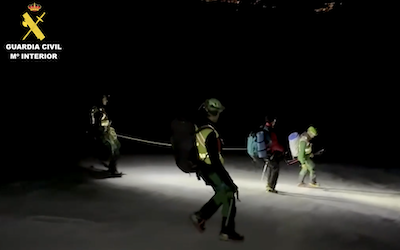
So the old tried-&-trusted, Guardia Civil, mountain-rescue service (GREIM) was called out. Their helicopter flew them to a spot above the Poqueira Refuge. From there, they had to trudge a distance of eight kilometres, battling strong winds and poor visibility; the same conditions that had prevented the chopper getting them any closer to the stranded women.
Whilst they were on their way, two other team members caught a ride on a ski-station snow tractor to the Collado de la Carihuela, and then continued on foot. However they were informed that the victims were safe and sound at the Villavientos Refuge and turned back.
This mission was no easy feat as ice-laden wind gusts, freezing temperatures that iced over suits and goggles, and poor visibility made the operation dangerous.
The first group that reached the refuge had to spend the night with the two climbers because of the darkness & blizzard and because everybody was too exhausted to continue. The following day, despite continued high winds, the helicopter reached them and evacuated everybody to Granada airport. The climbers did not require medical attention.
The second rescue, which lasted 12 hours, occurred on Monday on Puntal Tajos Negros in Güéjar Sierra. A 20-year-old man, who had been out hiking found himself in serious danger. It was at 18:40h when he contacted 112 and explained where he was and that he was unable to continue. He lacked proper mountain gear or warm clothing.
So the rescue team set out with all their equipment, as well as warm clothes and food etc for the man. they had had to set out on foot because it was getting dark and the helicopter can’t be used after nightfall for crew-safety reasons.
The remote area where the man was is over 2,750 metres up so the rescuers had to walk for hours to reach him, struggling on, using crampons and ice axes. They found him five hours later suffering from severe hypothermia.
Wrapping him in warm clothing and having fed him, they set off back down again, reaching Peña Partida Refuge around 06:00h the next morning. The helicopter was waiting there to evacuate the man to hospital.
Finally, we come to the Junta de Los Ríos in Otívar on the 17th around 14.00h. An abseiler had injured himself within this steep-sided ravine, having suffered a probabey fracture in his foot. The team patched him up, using a splint and bandages and flew him and his companion to the Hospital Traumatología in Granada.
Editorial comment: the Sierra Nevada might look picturesque from down on the coast or in the vega of Granada, but they are lethal in winter, but some people continue to go up there without adequate clothing and equipment, or food & water in case of an emergency.
(News: Sierra Nevada & Otivar, Granada, Andalucia)
Keywords: Mountain Rescue Missions, Capileira, Junta de Los Ríos, Güéjar Sierra, Poqueira Refuge, GREIM, Mountain Rescue, Helicopter
news, andalucia granada, sierra nevada, costa tropical, otivar, mountain rescue missions, capileira, junta de los ríos, güéjar sierra, poqueira refuge, greim, mountain rescue, helicopter
People should have to either pay a fine for being incredibly reckless, take out the suggested just-in-case necessities, or take out insurance to partially cover costs of these situations. I do feel that insurance should be taken out by more people – not that I’m in that business. But cycling. Electric bikes and scooters do have issues at times. Perhaps, too, the enforced wearing of protective helmets – skull injuries tend to be long lasting.