
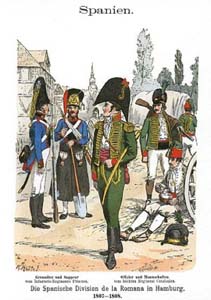
 When the Spanish troops of 15,000 soldiers under the command of the Marquis de La Romana, arrived in Denmark in 1808 it was to join forces with the French-Belgian troops sent by Napoleon Bonaparte to invade Sweden.
The troops were invited by the Danish king Christian VII as allies to protect Denmark in a time where British warships had control of the seas.
A story goes that when the king saw all the foreign troops he had a heart attack and the message of his death was passed by a Spanish soldier with the words: King kaput!
Now being King of Denmark, Frederik VI, he thought that with the help of the Emperor Napoleon he could also become king of the Swedes and bring back the honour and humiliation to Denmark by having lost the famous and greatest fleet of Denmark ever.
But Napoleon had other plans, he was not spending any money on the soldiers in Denmark, as they where hosted by the Danish kingdom. In the meantime his plan was to install his brother Joseph as King of Spain, also known as Pepe Botella (wonder why?).
British spies in Denmark helped about 10,000 Spanish soldiers to be evacuated in ships and had them sailed back to Spain to fight against the invasion of their own country.
The fleeing Spaniards were then declared traitors to the Danish Crown and then treated as such.
Never before had the Danes had the opportunity to encounter with such exotic people as the Spanish. Suddenly a mini society of Spain was established. The troops had arrived with cooks, priests, wife and children even. Most of these were to live with Danish families and adapt to the day-to-day life of the countryside in the provinces.
The French-Belgian troops had not integrated very well, especially food-wise, they would wrinkle their nose at our famous øllebrød, (mixture of beer, rye bread and sugar, boiled into some kind of porridge), whereas the Spanish would not, and that impressed the Danes. They fully integrated, to such an extent that still today there is a saying in Denmark that all brown-eyed Danes are descendant of those Spanish soldiers.
The impression was such a new thing for the Danes: these dark handsome people that played the guitar, sang and danced; they were always happy and fit for a fiesta. They taught the Danes to roll tobacco with paper, and make vinaigrette for the salads and also to use garlic and plant them. Also they showed that snails and frogs could be a culinary experience. People were also impressed by the Catholic Mass as opponent to the austere Danish church.
From this, of course, also many romantic alliances were introduced. It was not seen as shameful when Danes and Spanish courted and offspring started to appear with brown eyes and dark-brown hair.
The handsome Spanish officers knew how to treat a lady and surely the Spanish soldiers must have been very interested in conquering the blond and fair Danish young women. It was better to say that a Spaniard was the father of a child with the exotic looks, than a gypsy or a charcoal burner.
A story goes that a Spanish soldier that broke his leg and couldn’t reach the evacuation by the British fleet from Langeland, and stayed in Denmark, married and had nine children with his Danish wife. Another one tells of a Spanish noble man who preferred to put a bullet in his head, rather than surrender to the French troops. There is also a tale about how the Spanish
soldiers burned down the castle of Koldinghus by accident, because they where so bitterly cold that they had put too much firewood in the fireplace.
H.C. Andersen wrote in his memoirs (Mit livs eventyr) in 1832: “At that time, I was no more than 3-years old, but I do remember quite well, that these black-brown people who made noise in the streets. The cannons that were fired from the square and in front of the Bishops-yard; I saw those foreign warriors laying on the pavement and on bundles of straw in the destroyed church of Graabrødre…
The French soldiers were always mentioned as arrogant and bossy, and the Spanish as good-natured and polite, and between them both the spitefulness was deep; the poor Spaniards were most liked.
One day a Spanish soldier took me in his arms and pressed my lips against a silver-picture he had by his chest. I remember my mother got quite angry by this, it was something Catholic, she said, but I liked the picture and the foreign man that danced around with me, who kissed me