
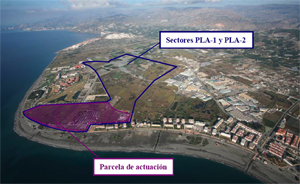
 The Spanish term, el Cuento de la Lechera, roughly corresponds to ‘building castles in the sky,’ and that is the expression that the Ecologistas en Accion have used to describe Motril’s plan to build an inland marina. They point out that the Town Hall is claiming the coming generation of jobs and businesses, thanks to the project, but without taking into account the social-economic reality of the area nor the crisis in which we find ourselves.
The ecologists indicate that Motril’s hopes and calculations are based on a report from the University of Granada, but one, according to the ecologists, that bears no author’s signature; i.e., nobody has taken responsibility for producing it.
The said report compares Granada’s available port berths with those of Malaga and Cadiz, interpreting the result as a ‘deficit.’ The ecologists, on the other hand, consider this a fallacy as in those two Andaluz provinces 90% of the total population live on the coast, whereas in the case of Granada, the figure is only 15%. Therefore it is logical, they consider, that they would need more berths. In the case of Cadiz, when the fishing fleet is taken into consideration, which is probably the biggest in the region, the comparison is even more unsuitable.
The ecologists find the conclusion drawn by the report as ‘mind-blowing;’ i.e. 800 berths creating 18,750 jobs within a decade, 1,784 long-term and 61 short-term job contracts each year, and yet the report itself admits that the marina will only generate 18 jobs, half of which will be managerial.
What most attracts criticism within the report, is the conclusion that 3,019 new goods transport and 238 new passenger licences will be needed, thanks to the construction of the Marina. The ecologists remark, with a certain sarcasm, that it would appear that everybody in Motril is going to be a lorry or taxi driver.
Next, the ecologists turn their critical eye on the project developers who claim to ‘altruistically renounce’ the use of 64,653 sq/m of building land and four hotels permitted in the PGOU in exchange for a strip of water occupying 90,155 sq/m, but what they do not mention, say the ecologists, is that the marina project contemplates the building of 16 new hotels and 3 tourist complexes, whilst the commercial ceiling exceeds by 3,000 sq/m the maximum permitted in the PGOU of 12,840 sq/m. These figures indicate the true intention of the developers, they believe.
The report remains silent on the excavation needed to create the marina, which will take an 80,000 sq/m chunk out of the vega. This artificial ‘basin’ of sea water will put the Motril-Salobrena water table in direct contact with the sea, they claim. They underline the fact that the water table is almost at ground level in this area. The ecologists mention that this water table is already damaged by the Rules Dam, denying the area its natural replenishment and the drop in irrigation owing to crop reduction.
The ecologists then turn their attention to the breakwaters/groynes that will be built at the mouth of the marina, which receive a glowing assessment by the developers as being positive for the immediate coastline, as they will ‘create beaches,’ but at the same time recognise that first of all the sediment/sand will have to be provided so that the sea can move it into place through natural tidal and wave action.
Then they criticise the fact that the entrance 60-metre-long channel, effectively severs the coast, isolating the two sides as the project foresees no alternative transit.
Finally – and this is a pretty extensive press release from the ecologists, so we haven’t included everything mentioned, they draw attention to who is behind the project; i.e. 29 entities from different economic sectors, representing 150 businesses and two banks. The two banks are Caja Granada and Caja Rural, which, they emphasise, have received strict instructions from the Bank of Spain to refrain from investing in ‘bricks,’ i.e., real-estate projects, they claim.
(News: Motril, Costa Tropical, Granada, Andalucia)
[nggallery id=79]