
Valle de la Orotava, Tenerife — Listán Negro: wines arrive carrying their landscape in a bottle, 7 Fuentes comes with a volcano under the cork.
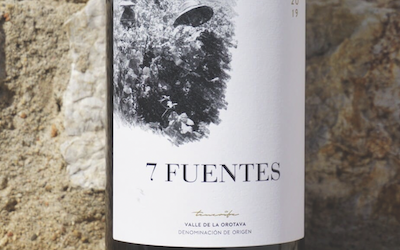
Suertes del Marqués has single-parcel labels, but 7 Fuentes is their village wine: a red assembled from different small plots across the Valle de la Orotava, combining estate fruit and grapes from local growers.
The name feels apt: not one source, but several springs feeding the same volcanic channel. Different altitudes, exposures, soils and vine ages are brought together to form a portrait of the valley rather than a close-up of one slope.
Valle de la Orotava is not an enclosed valley in the postcard sense, but the long northern descent of Teide towards the Atlantic.
The vineyards sit between volcano and ocean, under the influence of trade winds, humidity, sudden cloud, sharp light and old black soils. Banana plantations, stone walls, steep roads, Atlantic mist and impossibly old vines all share the same visual field. This is Tenerife away from the beach brochure: agricultural, humid, dramatic, a little unruly.
The traditional training system is one of the great visual signatures of the place: cordón trenzado, the braided cordon. We are familiar with the tidy vertical rows, instead, here the vine arms are twisted and extended horizontally, sometimes for many metres, like old ropes laid across the slope.
It is a system of patience and inheritance. You look at these vines and think of hands, years, repairs, stubborn families and a way of farming that survived in spite of the demand for modern efficiency. Many of these vines are ungrafted, protected historically by Tenerife’s isolation and volcanic soils, which gives the wine an extra layer of pre-phylloxera memory.
The wine is mostly Listán Negro, the Canary Islands’ most important red variety and one of Tenerife’s defining grapes. Pale-coloured, aromatic and agile, it gives wines shaped by red cherry, wild strawberry, pomegranate, pink pepper, dried herbs, floral notes, volcanic dust and a faint smoky edge.In Tenerife, old ungrafted vines, volcanic soils and Atlantic humidity sharpen these qualities, adding fine tannins, mineral texture, freshness and a clear sense of place.
In the glass, 7 Fuentes is pale ruby, translucent and bright, with a colour that immediately suggests delicacy, fragrance and lift. Pale, yet full of aromatic detail: red cherry, wild strawberry, pomegranate, rosehip and orange peel rise first, followed by pink pepper, dried thyme, bay leaf, black tea and a fine smoky-mineral note.
With air, the wine becomes more savoury and more precise. The fruit stays red and fresh, while the volcanic register deepens into ash, warm stone, pumice dust and a faint ferrous edge. There are also small touches of tomato leaf, cured olive and dry earth, giving the nose a beautifully agricultural character — fruit, herb, soil and Atlantic air held together in one line.
On the palate, the pale colour translates into agility and tension. The wine moves lightly, but with real grip: fine dusty tannins, bright red fruit, peppery spice and a mineral texture that gives the mouthfeel shape. Sour cherry, raspberry skin, pomegranate, dried herbs, black tea and orange peel carry through to the finish, where the volcanic bitterness becomes clean, savoury and mouth-watering.
The pleasure here is in precision rather than volume: aromatic clarity, red-fruited energy, herbal detail, smoky stone, fine tannin and a long, salty-mineral aftertaste. It is a wine with light in its body and grit in its bones.
Serve it slightly cool, around 12–14°C and give it a little air, along with Canarian flavours: papas arrugadas with mojo rojo, grilled goat’s cheese, chickpea stew, rabbit in salmorejo, garbanzas, grilled pork, or a simple plate of charred peppers and mushrooms.
88-90 Bruja points. 12.65 € from Bodaboca.com
(News/Feature/Wine: 7 Fuentes, Suertes del Marqués)
Keywords: Suertes Del Marqués, 7 Fuentes, Teide, Canary Islands, Listan Negro
news, wine column, suertes del marqués, 7 fuentes, teide, canary islands, listan negro