
Researchers from the Universities of Granada and Málaga have identified the cause of the rapidly growing invasion of the Asian seaweed.
The cause for the appearance of this invasive species that is causing such a problem along the coast of Andalucía is: asexual reproduction through cloning.
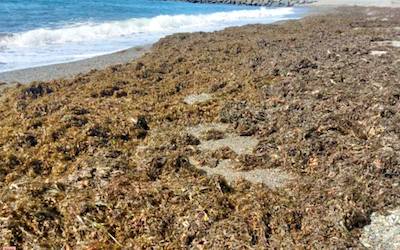
A single individual can generate over half a million potential specimens per square metere each year, peaking in spring and summer.
While it can reproduce sexually in its native Pacific habitat, it relies almost exclusively on clones (propagules) and asexual spores in our waters.
Furthermore, because it can live and travel within the water column without settling, it spreads quickly and forms large floating masses.
The consequences are that It displaces native species, reduces oxygen & light as it rots, and threatens protected posidonia meadows and corals.
Things are exhasperated because It lacks natural predators, clogs fishing nets, reduces catches, and costs municipalities heavily for beach cleanup to protect tourism.
So, what can be done about it? Scientists suggest that while total eradication is difficult, selective removal during peak reproductive seasons could give native species a chance to recover. A part from that… I suppose we are just going to have to eat it! Joking!
(News: Andalucia)
Keywords: Invasive Seaweed Problem, posidonia meadows, Researchers, Granada University, Málaga University, Cloning
news, andalucia, invasive seaweed problem, posidonia meadows, researchers, granada university, málaga university, cloning
Excellent point – hadn’t thought of that.
The standard minimum process for converting seaweed to fertilizer involves rinsing to reduce the salt content. My point is that most fertilizer is derived from fossil fuels using chemical processes; if there is a problem with excessive seaweed, can it not be collected, rinsed to reduce salt content and used locally, thus reducing damage to the environment and helping with the pollution problem, possibly saving money as well. Is there anyone working on this in agricultural acedemia that can offer comment?
Apart from the high salt content, why not, indeed? Perhaps as a cattle-feed component?
Is it possible that it could be processed for use as fertilizer?